FWDI funding was negative on Binance and KuCoin, yet the pair earned 0.50% every 8 hours
Nov 25, 2026
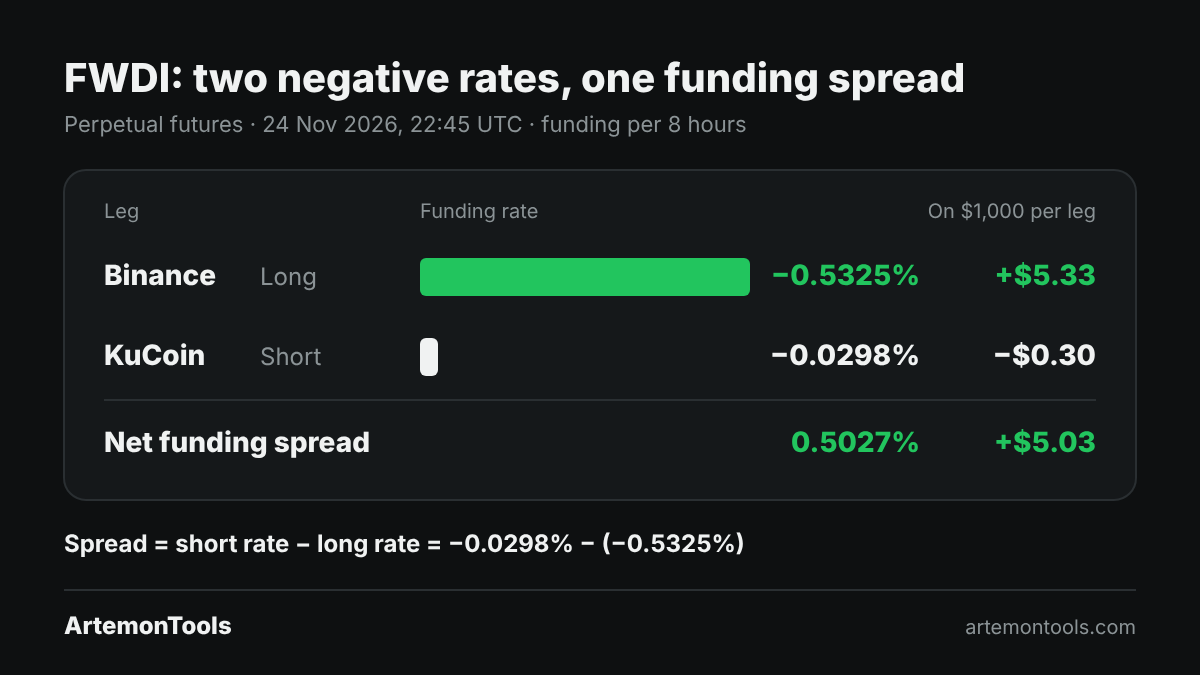
At 22:45 UTC on 24 November 2026, funding on the FWDI perpetual was negative on two exchanges at once: −0.5325% on Binance and −0.0298% on KuCoin per 8 hours. Two minus signs look like nothing to collect, yet the pair long Binance / short KuCoin earned a net 0.5027% every 8 hours, which the ArtemonTools scanner annualized to 550.5%. What matters is not the sign of each rate but the gap between them.
What the scanner showed
FWDI is a perpetual futures contract on a stock: it has no expiry date, follows the share price and trades on crypto exchanges. At the snapshot it cost $3.491 on Binance and $3.49 on KuCoin, practically the same price. Both exchanges settle funding every 8 hours, and the next payment on both was due at 00:00 UTC, 75 minutes later. The pair is on the FWDI Binance–KuCoin chart.
Who pays whom when both rates are negative
Funding is a payment between the two sides of a perpetual contract. When the rate is positive, longs pay shorts. When it is negative, shorts pay longs. The rate is a percentage of the position size, charged at every settlement.
At −0.5325%, every FWDI short on Binance paid 0.5325% of its position to Binance longs. At −0.0298%, every short on KuCoin paid 0.0298% to KuCoin longs. In a pair with a long on Binance and a short on KuCoin, the first leg receives a large payment and the second leg makes a small one. One leg earns, the other costs, and the income is the difference.
The rule: short rate minus long rate
A funding spread is always counted the same way, whatever the signs: the rate on the short leg minus the rate on the long leg. Here that is −0.0298% − (−0.5325%) = 0.5027% per 8 hours. Subtracting a negative number adds it, which is why two negative rates can make a large positive spread.
The same rule tells you which way round to open the pair. The long goes where the rate is lower, the short where it is higher. Reversed, long KuCoin / short Binance, the same numbers give −0.5027%: that pair would pay 0.5027% every 8 hours instead of earning it. The scanner puts the legs in the right order; the formula lets you check it by hand.
What it earns in dollars
Take $1,000 in each leg. At the 00:00 UTC settlement the Binance long would receive $5.33 and the KuCoin short would pay $0.30, a net $5.03. Three settlements a day make about $15.08, or 1.508% of one leg. Multiply 0.5027% by 3 payments a day and 365 days and you get the 550.5% APR shown by the scanner.
The hedge is what makes this a spread trade rather than a bet on direction. A long on Binance alone would collect the full $5.33, but it would also gain or lose with every move in FWDI. The KuCoin short removes that price risk for $0.30 per settlement, about 6% of the income.
Opening the pair had a price too. The entry spread was −0.229%: buying at the Binance ask and selling at the KuCoin bid cost $2.29 on $1,000 per leg. The exit spread was 0.00%, so closing straight away would add nothing more. One settlement covered the entry about twice over. Fees for the four trades come on top; the funding rate arbitrage calculator shows how many payments they take.
Why one exchange charged almost 18 times more
The two contracts cost the same, so the gap between the rates did not come from a price gap between the exchanges. Each exchange sets its rate from how its own contract traded against its own spot index during the interval. On Binance FWDI had $295,413 of open interest, the value of all open positions, and shorts there were paying heavily to stay short. On KuCoin open interest was $99,078 and the rate stayed close to zero. More on this in what funding is actually measured against.
What can break the trade
- The rate is a forecast until settlement. Before each payment exchanges show an estimate that keeps changing until the settlement time. An extreme rate like −0.5325% is often followed by a smaller one once shorts close or the price moves.
- Timing. With an 8-hour interval there are only three payments a day, and only positions open at the settlement moment receive them. Opening five minutes after 00:00 UTC means waiting almost 8 hours for the first payment while the rate can change.
- The thin leg. KuCoin had $1.11 million of 24-hour volume and $99,078 of open interest, against $1.48 million and $295,413 on Binance. A larger order moves the KuCoin price, and the entry spread with it.
- Price gaps between the legs. The prices matched at the snapshot, but each leg needs margin for the moment they do not: a leg liquidated on a price spike no longer hedges anything. Before relying on these numbers, check the live FWDI pairs in the funding scanner.
The short version: read a funding pair by the gap between the rates, not by their signs. Two negative rates, two positive ones or one of each follow the same rule: short minus long. All numbers are a snapshot from the ArtemonTools scanner at 22:45 UTC on 24 November 2026; FWDI rates have been settled at least once since then.
