SK Hynix 2.14% cheaper on Hyperliquid than on Binance: how stock perpetuals trade while Seoul is closed
Nov 27, 2026
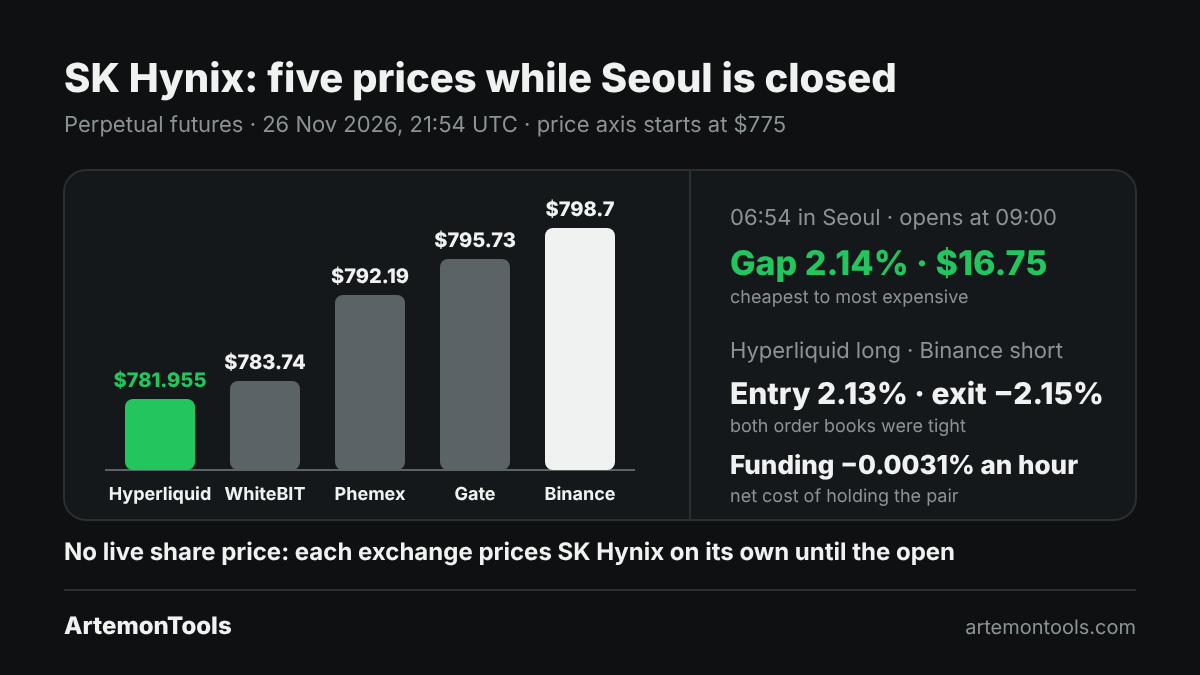
At 21:54 UTC on 26 November 2026, an SK Hynix perpetual cost $781.955 on Hyperliquid and $798.7 on Binance, a 2.14% gap on one of the largest memory-chip makers in the world. It was 06:54 in Seoul and the Korean stock market was closed: with no live share price to follow, each exchange's contract drifted on its own order book.
Five prices for one share
SK Hynix is a Korean company whose shares trade on the Korea Exchange in Seoul. Crypto exchanges list perpetual futures on it: contracts with no expiry date that follow the share price and settle in USDT or USDC. At the same moment the ArtemonTools scanner saw five prices for one share: $781.955 on Hyperliquid, $783.74 on WhiteBIT, $792.19 on Phemex, $795.73 on Gate and $798.7 on Binance. From the cheapest to the most expensive is 2.14%, or $16.75 per share.
Why the prices split: the anchor is switched off
A perpetual stays close to its underlying asset through an index price taken from the spot market. For a crypto coin that market never closes. For a share it does: the regular session in Seoul runs from 09:00 to 15:30 local time, which is 00:00 to 06:30 UTC. After the close the perpetuals keep trading around the clock, but nothing fresh comes in from the stock exchange. Each venue decides what its contract follows until the next open, and they decide differently.
trade.xyz, which runs the stock markets with the xyz: prefix on Hyperliquid, says in its documentation that while the reference market is closed the external price stays fixed at the last close, and the oracle moves with the market's own trading. Price moves are limited by "discovery bounds" around a reference price. Other exchanges apply their own rules for closed hours. In practice each contract follows its own crowd of buyers and sellers, which is why five venues showed five prices.
Is the gap real? Compare entry and exit
A wide gap often means that one order book is almost empty. Not here. The entry spread, buying on Hyperliquid at the ask and selling on Binance at the bid, was 2.13%. The exit spread, doing the reverse, was −2.15%. They differ by only about 0.01%, so both books were tight, and the two legs traded $354.8 million and $1.23 billion in 24 hours. The gap was a real disagreement about price, not an empty book.
Another Korean share showed the same picture on the same two exchanges at the same moment: Hyundai Motor was cheaper on the first one, with an entry spread of 1.09% and an exit spread of −1.39%. Two stocks from one closed market, shifted in the same direction, point to a market-hours effect rather than a problem with a single contract.
What happens at the open
At 09:00 in Seoul (00:00 UTC), about two hours after this snapshot, live share prices return and each contract is pulled back toward them. The open decides which side moves. If the share opens near $798, Hyperliquid has to rise; if it opens near $782, Binance has to fall; or both can move part of the way. A pair that is long on the cheap exchange and short on the expensive one does not depend on that direction: it gains only if the gap narrows, and loses if the gap widens before it is closed.
The open can also be rough. Cointelegraph reported that earlier in 2026 the mark price of the xyz SK Hynix perpetual fell nearly 19% after one abnormal external price print, which caused liquidations; trade.xyz said it would reimburse eligible traders. A jump like that can liquidate one leg of a pair before the other leg makes up for it.
What holding the pair costs
While waiting for the open, the pair pays funding, the regular payment between longs and shorts. On Hyperliquid the long paid 0.0111% every hour, and on Binance the short received 0.00796% every hour. The net is −0.0031% an hour, about −0.074% a day: small next to a 2.13% entry, but trading fees on four fills (two to open, two to close) come on top. Funding on SK Hynix disagreed as much as the price did: from −0.68695% every 8 hours on Phemex, where shorts pay longs, to +0.53354% every 8 hours on WhiteBIT, where longs pay shorts.
What to check before trusting such a gap
- Market hours. For a stock perpetual, check whether the home exchange is open. A gap that appears after the close is a gap between two guesses.
- Exit spread. If entry and exit spreads are close in size, both books are tight; if the exit is much worse, one leg is thin.
- Corporate events. Splits and dividends also change a share price overnight: see how a stock split creates a fake spread.
- Live data. These numbers are a snapshot. Compare the SKHYNIX pairs in the scanner now and the SK Hynix Hyperliquid–Binance chart.
In short: a stock perpetual is anchored to its share only while the stock exchange is open. When Seoul is closed, each crypto exchange prices SK Hynix on its own, and gaps of 1–2% can appear even between large, liquid markets. All numbers are a snapshot of the ArtemonTools scanner at 21:54 UTC on 26 November 2026 and have changed since.
